
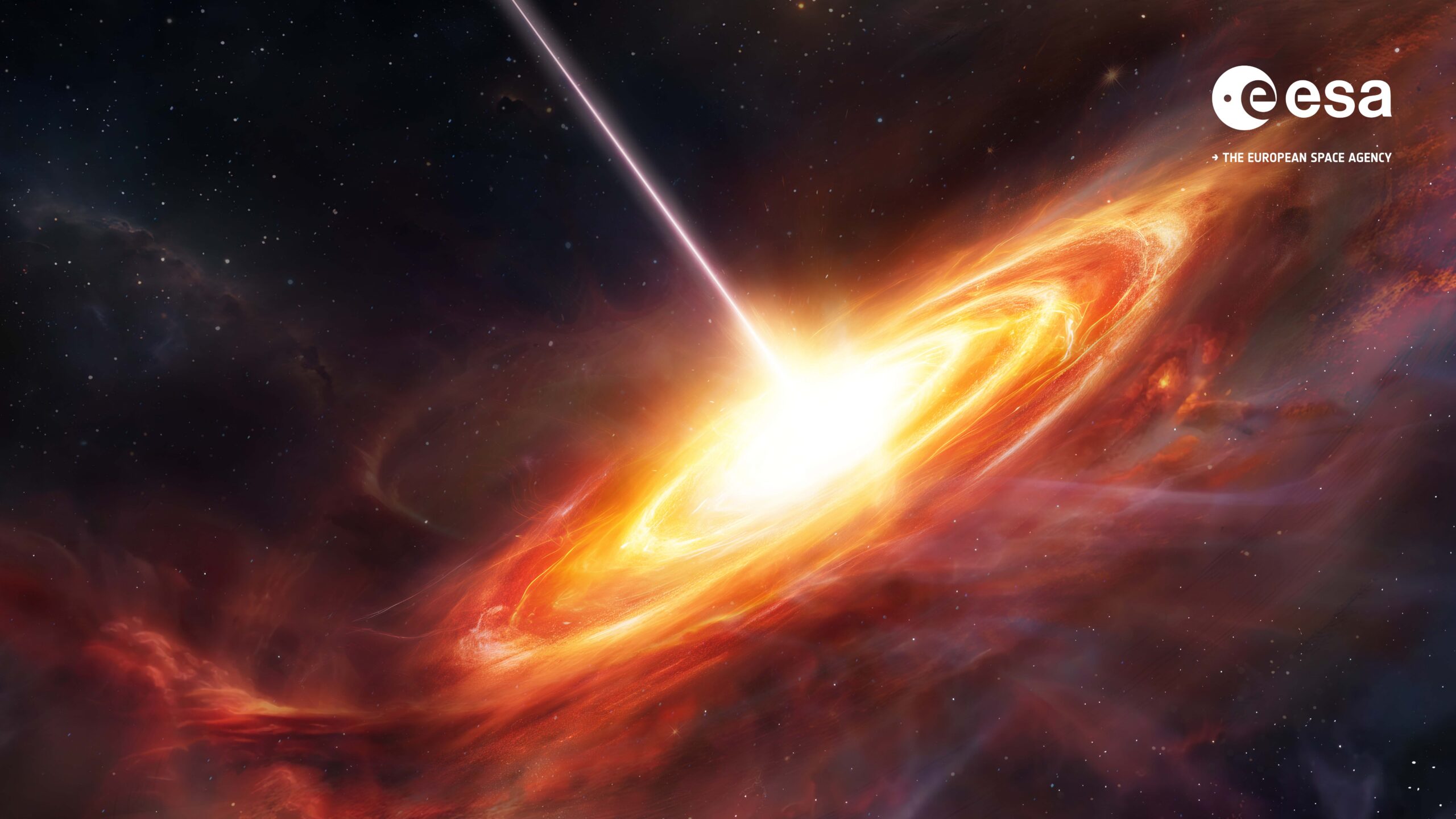
Recent astronomical discoveries have unveiled 31 quasars dating back to a time when the universe was only 600 to 800 million years old, a mere fraction of its current age. This discovery, spearheaded by an international team including researchers from the University of Arizona’s Steward Observatory, provides a significant leap forward in understanding the primitive universe.
These findings, detailed in the July 6 publication of Astronomy & Astrophysics, include the two most distant quasars ever observed. Among them is EUCL J172902.75+641018.1, now recognized as the most distant quasar on record, dating back approximately 670 million years. This discovery surpasses the previous distance record by 15 million years.
Quasars, known for their extreme brightness and energy, originate from supermassive black holes at the centers of galaxies. Their luminosity allows them to be visible across vast cosmic distances, effectively illuminating the epoch of reionization—a period when the first stars and galaxies ionized the dark hydrogen fog of the early universe. However, identifying quasars from this time is challenging due to their rarity and because the light they emit falls into a part of the spectrum where Earth’s atmosphere emits strongly, complicating detection.
To date, only nine quasars have been confirmed beyond a “redshift seven” distance, meaning their light took nearly 13 billion years to reach us. This number has now increased to 23, thanks to the recent findings.
Current scientific understanding struggles to explain how supermassive black holes, with masses billions of times that of our sun, could have formed so quickly after the Big Bang. The influence these black holes had on the universe’s reionization and their host galaxies remains unclear. “With only a few quasars known beyond redshift seven, we simply cannot answer these questions,” explained Daming Yang, a doctoral student at Leiden Observatory. “Finding more of them at such distances – and pushing to even greater distances – is the only way forward.”
The Euclid Consortium team utilized a novel approach to make these discoveries. They began with machine learning algorithms to scrutinize images from Euclid’s optical and near-infrared bands, identifying potential quasars. Subsequent ground-based observations from facilities like the Keck Observatory in Hawaii, the Magellan Telescopes in Chile, and the Large Binocular Telescope in Arizona confirmed 31 early-universe quasars.
“The quasars presented in this paper are fainter, less luminous, and have somewhat lower-mass black holes than the ones that we discovered before,” stated Xiaohui Fan, Regents Professor of Astronomy at the University of Arizona Steward Observatory. With Euclid’s capabilities, researchers can now explore smaller and less luminous quasars than previously possible.
Further observations and analyses were conducted by Fan’s team at the University of Arizona, employing large telescopes to capture long exposures and analyze spectra of faint objects.
“This is truly exciting,” remarked Jinyi Yang, a former assistant research professor at Steward and now an assistant professor at the University of Michigan. According to Yang, these quasars provide “invaluable insights into how the cosmos emerged from darkness and how the earliest supermassive black holes formed.”
The Euclid Space Telescope, launched in 2023, is revolutionizing the study of quasars with its extensive depth and sky coverage. Its Near-Infrared Spectrometer and Photometer, along with the Visible Camera, allow for unprecedented sensitivity, reaching magnitudes up to 24.5 in the near-infrared and identifying quasars significantly fainter than previous surveys.
“We are reaching the limit of what ground-based observations can give us,” noted Fan. “Euclid allows us to find them, but to obtain the high spectroscopic resolution, we have to turn to our ground-based observatories like LBT and Magellan.” As Euclid continues its six-year mission, it is expected to uncover hundreds more high-redshift quasars.
Silvia Belladitta, a postdoctoral researcher at the Max Planck Institute for Astronomy, highlighted that “discovery is only the first step.” Observing these quasars across the electromagnetic spectrum will further illuminate their environments and host galaxies. For instance, the second most ancient quasar is located within a galaxy actively forming new stars, offering clues about the nature of early supermassive black holes.
The next Euclid data release is anticipated for late 2026, promising to deliver the largest map of the universe ever created from space, combining infrared and visible light. Beyond charting quasars, this data will facilitate breakthroughs in other astrophysics areas, including insights into dark matter and dark energy by 2027.
The Euclid mission, a collaborative effort between the Euclid Consortium, NASA, and the European Space Agency, aims to map the extragalactic sky over six years, providing novel data to explore the nature of dark energy and dark matter. Launched in July 2023, Euclid began its cosmological survey in February 2024, involving over 2,000 members across 15 countries, including contributions from Canada, Japan, and the United States.
Read More Here







Comments are closed.