
Carnegie Mellon University’s (CMU) role in groundbreaking research continues to expand as its researchers engage in two pivotal projects funded under Phase II of the Department of Energy’s (DOE) Genesis Mission. These projects aim to harness AI to enhance our understanding of matter’s fundamental properties and boost advancements in fusion energy research.
The Genesis Mission is a collaborative initiative that seeks to accelerate breakthroughs in energy, scientific discovery, and national security. It connects AI, supercomputing, quantum systems, and advanced scientific instruments with the collective efforts of government, industry, academia, and philanthropy. CMU’s involvement is notable, already including the contributions of over a dozen scholars and researchers, as highlighted in a previous announcement.
Understanding Matter with AI
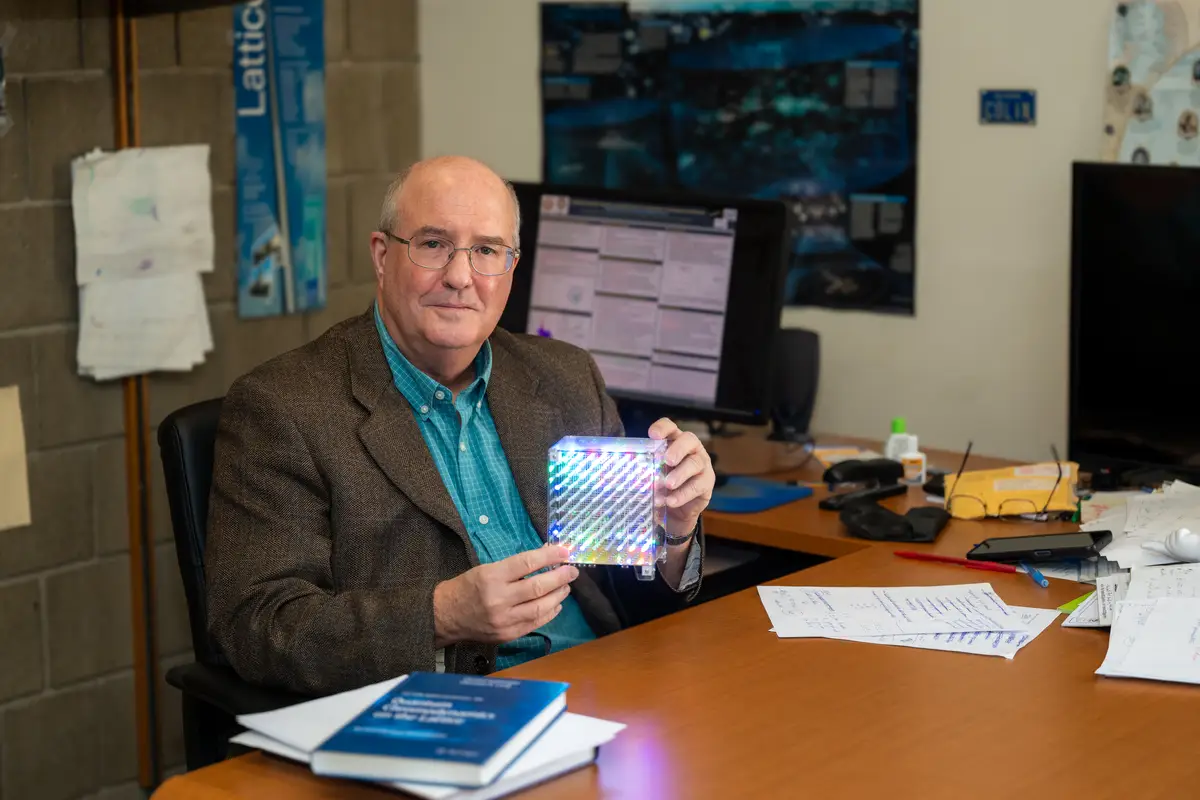
Professor Colin Morningstar from CMU’s Mellon College of Science is set to develop AI tools aimed at refining the complex calculations essential for studying the fundamental particles and forces governing matter. His research leverages supercomputer simulations to delve into the strong force that binds quarks and gluons into protons and neutrons.
As a co-principal investigator on the MIT-led project “Lattice QCD at the Intelligence Frontier,” Morningstar collaborates with experts from universities and national laboratories. Together, they explore how AI can enhance simulation efficiency, automate data analysis, and optimize scientific software. These advanced calculations are crucial for interpreting results from key particle and nuclear physics experiments. Morningstar noted, “The point of this award is to use new techniques to help us get around some of the stumbling blocks in our calculations. People have begun exploring how AI can assist with this work, but this project gives us the opportunity to take a much more focused approach and determine where these tools can truly make a difference.”
AI’s Role in Advancing Fusion Research
Jeff Schneider, a research professor at CMU’s Robotics Institute, is contributing to a Genesis project led by Commonwealth Fusion Systems (CFS). This project focuses on developing an AI-enabled digital twin of SPARC, CFS’s fusion demonstration machine, to improve tokamak control policies. By utilizing digital simulations, the project aims to expedite fusion research, crucial for addressing the increasing global energy demands.
These initiatives underscore CMU’s ongoing commitment to enhancing scientific research efficiency and effectiveness through AI tools that facilitate complex data utilization, idea testing, and experimental guidance.
Read More Here







Comments are closed.