
Unveiling the Secrets of the East Pacific Rise: A Pioneering Study on Submarine Volcanism
Exploring the depths of the ocean, McDermott and her team embarked on an ambitious mission to unravel the mysteries of the East Pacific Rise, a segment of the mid-ocean ridge renowned for its frequent volcanic activity. With voyages launched from ports in California, Costa Rica, and Panama, the researchers dedicated 20 to 30 days offshore per expedition.
This particular section of the ridge, described by McDermott as “fast-spreading,” experiences eruptions approximately every 15 to 20 years. Historical eruptions occurred in 1991-1992 and 2005-2006, marking it as a hotspot for volcanic activity. The National Science Foundation (NSF) had previously funded a long-term study, providing a robust foundation of knowledge and observations spanning 30 years.
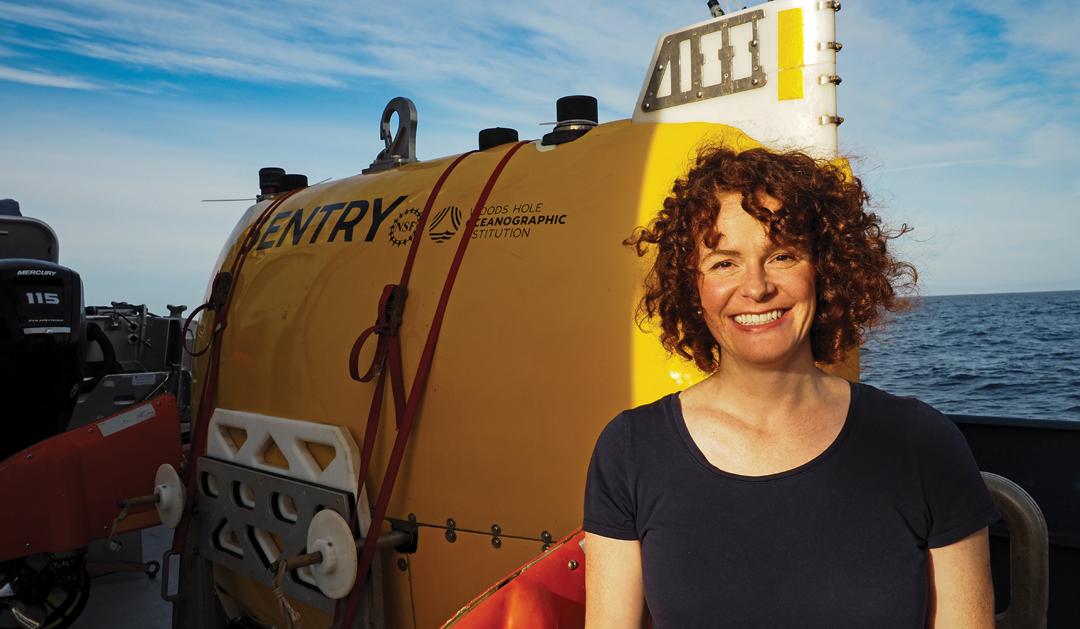
McDermott’s team chose this site for their NSF project due to the wealth of existing data and the expectation of another imminent eruption within the timeframe of their research. Initiating their study in 2018, they employed Sentry, an autonomous underwater vehicle from the Woods Hole Oceanographic Institution, to map the axial summit trough, a linear depression where eruptions frequently occur. This mapping was crucial for assessing new lava flows and quantifying their impacts.
The research team then developed a model to forecast volcanic eruptions, focusing on hot spring temperature observations. “Deep in the ocean, water boils at a higher temperature than at the Earth’s surface due to pressure,” McDermott explained. At a depth of 2.5 kilometers, the pressure is 250 times that on land, raising the boiling point of seawater to 390°C, nearly four times that of freshwater.
By positioning temperature sensors over vent sites connected to the magma lens, McDermott’s team collected high-resolution data every 10 minutes for up to two years. Their observations revealed that the “Bio9” hydrothermal vent hit its boiling point of 390°C during the 2005-2006 eruption. Utilizing temperature data and statistical modeling, they predicted an eruption in January 2025, with a margin of error of 1.5 years.
In February 2025, the team revisited the site but found no fresh lava despite strong vent plumes. “That was initially a little disappointing because we’d hoped to see an eruption, and also, that marked the end of our funded project,” McDermott noted. Nonetheless, they continued gathering data and submitted a peer-reviewed research paper with their prediction on April 27, 2025.
When Was an Underwater Volcano Eruption First Witnessed in Person?
In a groundbreaking moment for science, a separate expedition led by Wozniak from the University of Delaware witnessed a live underwater volcanic eruption on April 29, 2025. Using a human-occupied submersible, the crew observed red-hot lava, confirming the eruption. “This was the first time any humans had ever seen this,” McDermott remarked.
How Do Underwater Volcanoes Affect Earth’s Climate?
Volcanism plays a critical role in Earth’s climate system. Underwater eruptions contribute to the release of gases like carbon dioxide (CO₂), a greenhouse gas with climate implications. McDermott emphasized, “This balance between how much volcanism is happening versus how much CO₂ sinks solid forms is important to controlling Earth’s climate.”
While most volcanic activity occurs beneath the ocean, it often goes unnoticed. Submarine eruptions account for the majority of Earth’s volcanism, yet remain largely undetected due to their depth and lack of surface signals. This makes the April 2025 observation a notable discovery.
What Happens to the Seafloor and Hydrothermal Vents After an Eruption?
Following the eruption, McDermott’s team secured a new NSF award in fall 2025 to study the post-eruption aftermath. Returning to the site in January 2026, they collected time-sensitive fluid samples to understand the ecosystem’s transition back to equilibrium.
Read More Here








Comments are closed.